
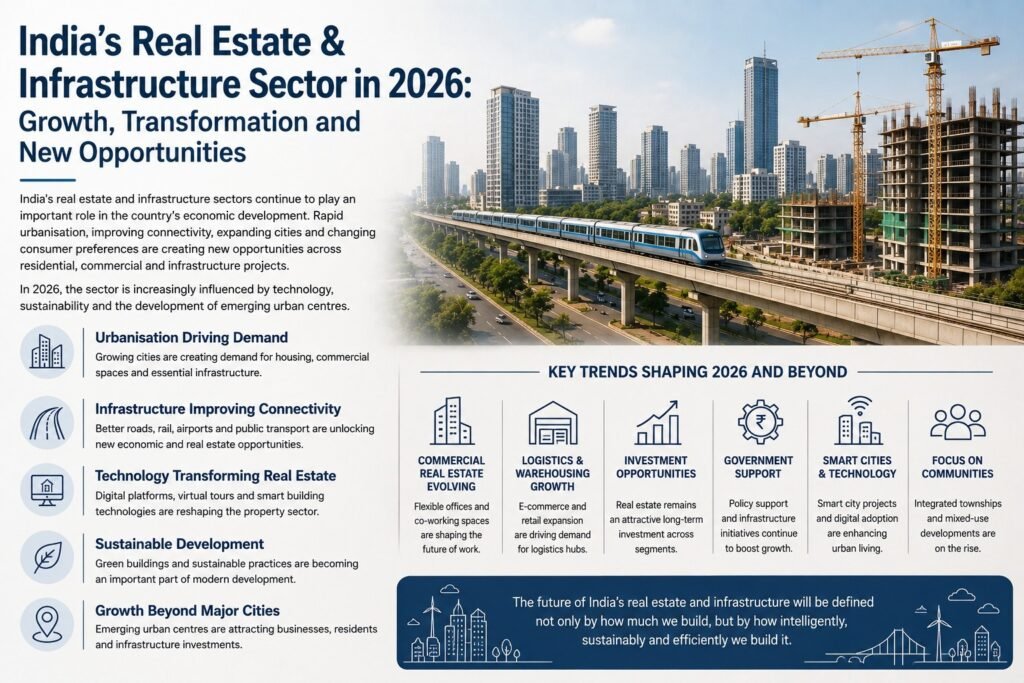
India’s Real Estate & Infrastructure Sector in 2026: Growth, Transformation and New Opportunities
India’s real estate and infrastructure sectors continue to play an important role in the country’s economic development. Rapid urbanisation, improving connectivity, expanding cities and changing consumer preferences are creating new opportunities across residential, commercial and infrastructure projects.
In 2026, the sector is increasingly influenced by technology, sustainability and the development of emerging urban centres.
Urbanisation Is Creating New Demand
As more people move towards urban and semi-urban areas for employment, education and business opportunities, demand for housing and commercial spaces continues to evolve.
Growing cities are also creating demand for roads, public transport, healthcare facilities, educational institutions, retail spaces and other supporting infrastructure.
This creates opportunities not only for property developers but also for architects, contractors, engineers, technology companies and service providers.
Infrastructure Development Is Changing Connectivity
Improved roads, transportation networks, airports, rail connectivity and urban infrastructure can significantly influence regional economic activity.
Better connectivity can make emerging locations more attractive for businesses, residents and investors.
As infrastructure expands beyond established metropolitan areas, new business and residential hubs can emerge around improved transport corridors.
Technology Is Transforming Real Estate
Technology is becoming increasingly important in the property sector.
Digital property platforms, virtual property tours, data analytics, automated customer communication and digital documentation are changing how buyers, sellers and developers interact.
Smart building technologies are also helping property owners monitor energy consumption, security and building operations.
Sustainable Development Is Gaining Importance
Environmental considerations are becoming an important part of modern infrastructure and real estate development.
Energy-efficient buildings, renewable energy integration, water management, waste reduction and sustainable construction practices can help reduce long-term environmental impact.
Green buildings can also provide operational benefits through improved energy and resource efficiency.
Growth Beyond Major Cities
Real estate opportunities are increasingly expanding beyond India’s largest metropolitan areas.
Emerging cities and developing urban centres are attracting businesses and infrastructure investment as connectivity improves and economic activity expands.
These locations can offer opportunities for residential projects, commercial developments, logistics facilities and industrial infrastructure.
Commercial Real Estate Is Evolving
The workplace has changed significantly in recent years.
Businesses are increasingly looking for flexible offices, technology-enabled workspaces and locations that support collaboration.
Co-working spaces and flexible office models have also become part of the changing commercial real estate landscape.
Logistics and Warehousing
The growth of e-commerce, organised retail and manufacturing is increasing the importance of logistics infrastructure.
Warehouses, distribution centres and industrial facilities are becoming strategically important for businesses that need faster and more efficient supply chains.
Locations with strong road and transport connectivity can become attractive hubs for logistics development.
Challenges Facing the Sector
Despite significant opportunities, real estate and infrastructure development can face challenges such as rising construction costs, regulatory requirements, financing conditions, project delays and changing market demand.
Successful development requires careful planning, transparent processes and longterm investment strategies.
The Road Ahead
The future of India’s real estate and infrastructure sector is likely to be shaped by a combination of urban growth, technology, sustainability and improved connectivity.
Developers and infrastructure companies that understand changing consumer needs and adopt modern technologies can be better positioned to take advantage of emerging opportunities.
Conclusion
India’s real estate and infrastructure sectors are closely connected to the country’s broader economic development.
As cities grow and connectivity improves, demand for quality housing, commercial spaces, logistics facilities and modern infrastructure is likely to create new opportunities.
The future of Indian real estate will not be defined only by how much we build, but by how intelligently, sustainably and efficiently we build it.
Keywords: Indian Real Estate 2026, Infrastructure India, Real Estate Trends,
Property Market India, Urban Development, Smart Cities, Construction Industry,
Commercial Real Estate, Sustainable Infrastructure