
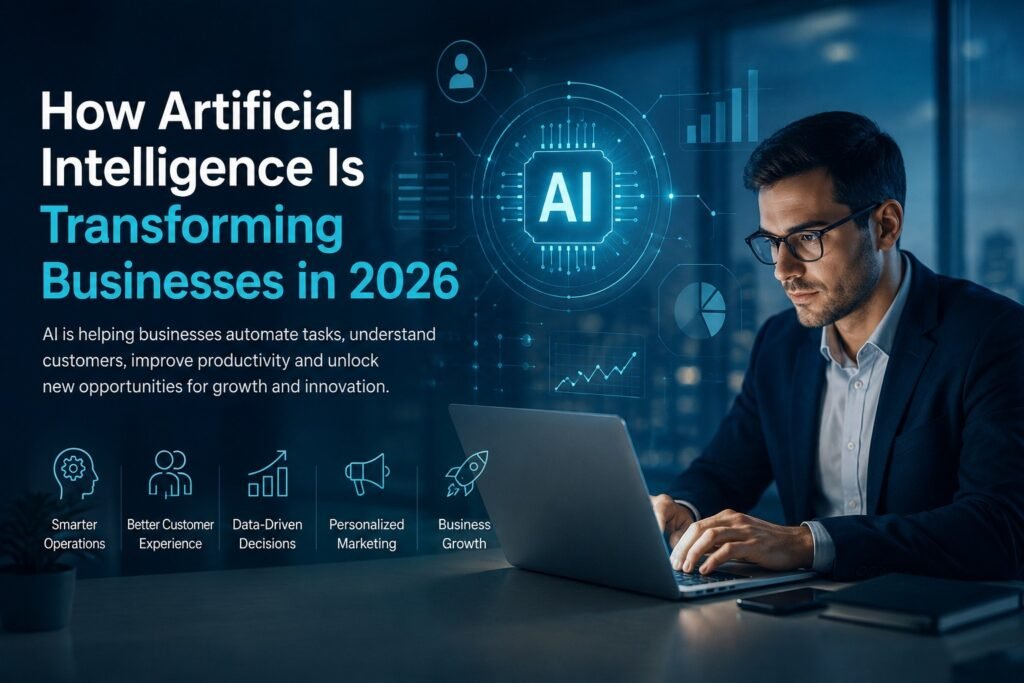
How Artificial Intelligence Is Transforming Businesses in 2026
Artificial Intelligence (AI) is no longer just a futuristic technology. In 2026, it has become an important part of how businesses operate, communicate with customers, analyse information and make decisions. From startups to large enterprises, companies across industries are exploring AI to improve productivity, reduce repetitive work and create better customer experiences.
AI Is Changing the Way Businesses Work
Traditionally, businesses depended heavily on manual processes for tasks such as data analysis, customer support, content creation and reporting. AI-powered tools are now helping organisations automate many of these activities. Employees can use AI to analyse large amounts of information, prepare reports, generate ideas, organise data and handle routine communication. This allows teams to spend more time on strategy, creativity and decision-making. The biggest advantage of AI is not simply automation. It is the ability to help businesses work faster, smarter and more efficiently.
AI and Customer Experience
Customer expectations are changing rapidly. People want quick responses, personalised recommendations and convenient digital experiences. AI-powered chatbots and virtual assistants can provide customers with instant answers at any time. Businesses can also use AI to understand customer behaviour and identify what products, services or information customers may be interested in. Personalisation is becoming particularly important in e-commerce, banking, hospitality, education and digital services.
AI in Marketing
Marketing is another area experiencing significant transformation. Businesses can use AI to study customer preferences, identify potential audiences and create personalised marketing campaigns. AI can also support content creation, advertising analysis, social media planning and customer segmentation. However, successful marketing still requires human creativity. AI can provide ideas and insights, but understanding a brand’s identity, emotions and audience remains an important human responsibility.
Small Businesses Can Benefit Too
AI is not limited to multinational companies. Small businesses, entrepreneurs and startups can use affordable AI tools for customer communication, market research, content creation, sales support, accounting assistance and business planning. For a small team with limited resources, the right AI tools can help increase productivity without requiring a large workforce. This could make AI particularly valuable for India’s growing startup and MSME ecosystem. The Human Role Remains Important One of the biggest discussions around AI is whether technology will replace human jobs. While AI is likely to automate certain repetitive tasks, it is also creating demand for new skills and roles. Businesses will increasingly need professionals who understand AI, data, technology and digital tools. Human qualities such as creativity, leadership, communication, emotional intelligence and critical thinking will remain highly valuable. The future is therefore less about humans versus AI and more about humans working with AI. Challenges Businesses Must Consider Despite its opportunities, AI also brings challenges. Businesses need to think about data privacy, cybersecurity, accuracy, ethical use of technology and responsible decision-making. AI-generated information can sometimes be incorrect, so important business decisions should not rely on automated outputs without proper human verification. Companies also need to train employees so that AI is used responsibly and effectively.
What the Future Looks Like
AI is expected to become increasingly integrated into everyday business operations. Instead of being a separate technology, it will become part of common business software, customer service platforms, marketing systems and workplace tools.Companies that learn how to combine AI capabilities with human expertise may gain a significant advantage in a competitive market.
Conclusion
Artificial Intelligence is reshaping the business landscape in 2026. It is helping companies automate routine processes, understand customers, improve productivity and explore new opportunities. However, technology alone cannot guarantee success. Businesses need the right strategy, skilled people and responsible implementation. The companies that succeed in the AI era will likely be those that understand one simple principle: AI is a powerful tool, but human vision remains the driving force behind meaningful innovation. Keywords: Artificial Intelligence, AI in Business, Business Technology, AI Trends 2026, Digital Transformation, Business Innovation, Startup Technology, Future of Business